On this day in 1882, Sir Hugh Dowding was born. The system of air defence he created, the Dowding System, was instrumental in the Battle of Britain, integrating ground-based defence systems such as antiaircraft guns with Allied aircraft and methods to detect incoming enemy planes.
Radar was an essential link in this defence, allowing the outnumbered RAF to rapidly locate and engage enemy aircraft. Although Dowding later fell out of favour with those in charge of the Air Ministry, the system he designed and implemented was vital for Britain’s defence.
Join us for a talk and to watch the classic film ‘The Battle of Britain’ on Sunday 12 May 6pm at Riverside Cinema, Woodbridge,
With a star-studded cast including Laurence Olivier, Trevor Howard, Michael Caine and Susannah York, this special screening includes a talk on just why the radar technology developed at Bawdsey was so vital to the outcome of the Battle of Britain.
Many will know the story of the Battle of Britain when the gallant ‘few’ defended our shores in their Spitfires and Hurricanes. What is far less well known is that experimental developments carried out in Suffolk in the years leading up to the outbreak of war enabled this success. Using radio waves to detect the presence of aircraft was first demonstrated in 1935. As a result, a team of scientists and engineers were sent initially to Orfordness and then to Bawdsey Manor. This work, carried out in haste and in great secrecy, turned the idea into a chain of coastal radar stations ready and able to defend the country.
A percentage of the ticket sales will go to the work being done by Bawdsey Radar Museum to share this important story of radar.
On this day in 1892, Robert Watson-Watt was born. In response to growing concern about the defence of British cities from aerial attack, Watson-Watt, with his assistant Arnold ‘Skip’ Wilkins, developed the world’s first operational radar station at Bawdsey in Suffolk.
This technology proved vital in WW2, allowing the outnumbered RAF to efficiently find and attack incoming Luftwaffe aircraft. Radar technology developed by Watson-Watt and his team continues to impact our lives today, from weather forecasting to astronomy and archaeology.
A Women’s Auxiliary Air Force (WAAF) veteran who was involved in the D-Day landings has died aged 107.
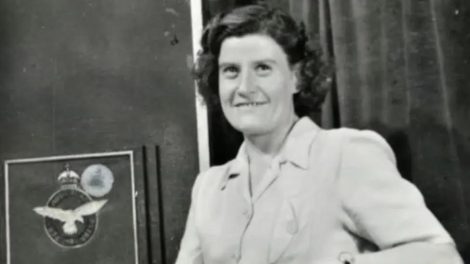
On 6 June 1944, during the Normandy landings, Rose Davies, as a radar operator, would play a key role in its success alongside hundreds of personnel in the UK, supporting Operation Overlord.
She was also a recipient of the Legion d’Honneur – France’s top military honour – for her radar surveillance work during the Second World War.
Rose married Wilfred Dawson and they settled in Beeston, Nottinghamshire. Wilfred, who served as a wireless operator on RAF Bomber Command in North Africa and Malta, flying on Wellington and Lancaster aircraft passed in 2021 aged 99.
In 2021, Rose Davies told more of her story in an interview with the Royal Air Force Benevolent Fund:
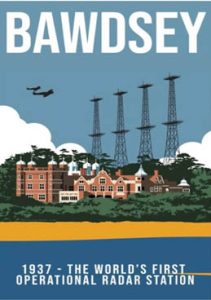
We are pleased to let you know our retro design tea towel is back in stock in the Museum Shop and Online!
This exclusive design was created by Nick Black, A Bawdsey Radar supporter, using a retro colour scheme to give a familiar picture a nostalgic but lively makeover. The presence of the four Transmitter Towers behind the Manor are a reminder that this was the place where RADAR was secretly developed
On This Day in 1991, the RAF Ensign was lowered for the final time at RAF Bawdsey.
Derek Rothery, the last station commander of RAF Bawdsey, remembers the official closing ceremony –
‘The date of Monday 25 March 1991 was selected. A Guard of Honour was formed on Bawdsey Quay, which was part of the RAF station. RAF Bawdsey was part of 11 Group, the old RAF Fighter Command in WW2, and we had Air Commodore Mike Donaldson from 11 Group HQ as our Reviewing Officer.
We had one police dog at the time, Air Dog Skip, who was on parade having been promoted that day to Corporal Air Dog Skip and he retired that day after the closure ceremony. It was a very moving ceremony with the General Salute, the National Anthem, prayers & an address by the Reviewing Officer which included a brief history about what happened at Bawdsey. The Ensign was lowered, folded, presented to me & I led the parade off in a slow march to the strain of Auld Lang Syne.
I’d spent six happy years on a station unlike any other with the role it played in air defence of the UK, I believe it was unique in the Air Force.
I was determined to be the last RAF serviceman to leave Bawdsey and I was.
As I walked past the guard-room I turned for a last look at the Manor and gave a final salute to all the personnel who had served at RAF Bawdsey’.
On this day in 1935, two men drove a van into a field near Daventry and proved that radar as an air defence system would work. The experiment they conducted helped win a battle in a war that had yet to start…
The two men were Robert Watson-Watt and Arnold Wilkins. With some poles, wires and a receiver in the back of the van, they proved that radio waves would bounce off an aircraft and those reflected waves could be picked up on a receiver. The aircraft could be detected.It was a breakthrough moment.
It was proof that radar would work. This field work became known as ‘The Daventry Experiment’. It was so successful that the government funded development of Radio Direction Finding as it was called before it was named Radar later in the war.
By 1937 three radar stations were built, Bawdsey Radar was the first. By 1939, there were 20 radar stations built and ready. The radar stations formed a protective chain of radar defence and was known as the Chain Home, the world’s first operational radar defence system.
The location near Daventry was chosen as it was close to BBC broadcasting transmitters. The aircraft that took part in this historic experiment was a Heyford Bomber.
You can see all these elements in the drawings below by Mark Beesley: the men, the van, the aircraft and the transmitter towers. The drawings feature on this special mug designed exclusively for Bawdsey radar Trust to commemorate the remarkable achievement 86 years ago.
It’s for sale from Bawdsey Radar online at £12.99 and is a unique piece of history telling.
Most of the Second World War radar transmitter towers have long since disappeared: the last Bawdsey tower came down in 2001. The one at Great Baddow that’s on the old Marconi site was originally at Canewden.
Look at this beaut at Steinigot in Lincolnshire: it’s listed and relatively complete.
Its 50 years since Robert Watson-Watt died. This past week @ScotlandsPeople released the records for everyone who died 50 years ago (or married 75 yrs ago or died 100 yrs ago in Scotland).
Here’s the link to Watson-Watt’s record with an article
 To place an online order click